Chan’s textile pieces at her new exhibition at Hong Kong’s SC Gallery explore fertility and ‘a sort of transcendence’
Published: 7:15am, 14 Oct 2025
One of the most talked-about works at the 2023 Art Basel Hong Kong fair was a giant plush installation depicting huge pieces of faeces oozing from a bunk bed.
This bizarre, unsettling, yet playful creation, called Poop Me To the Moon, tells you a great deal about the weird-and-wonderful world view of Hong Kong artist IV Chan Tsz-man.
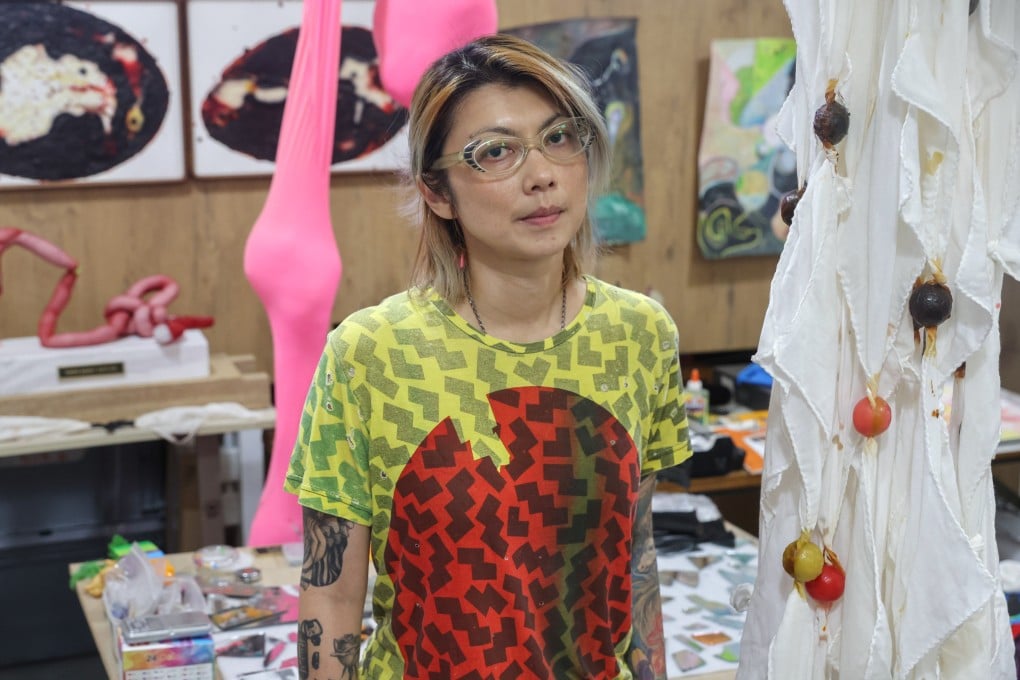
A sculptor, performance artist, costume designer and more, Chan makes intensely personal pieces that blend dry humour with a defiant look at women’s relationships with their bodies in a way that sometimes recalls the fabric art of Louise Bourgeois and Yayoi Kusama.
At her studio in Fo Tan, an industrial area in Hong Kong with many artist workshops, Chan says the relationship between bodies and materials is a central component of her art.
“My work very much begins from my own body experience, as I usually start by playing with materials and letting my subconscious take the lead. I always end up portraying the perspective of either a child or a mother,” the 47-year-old says.

While Poop Me to the Moon recalls a child’s fear of soiling the bed and mixes dreams and disgust, Chan’s focus on the body and its functions has also led to explorations of womanhood and fertility.
Part of that stems from how conscious she is of not fulfilling societal expectations by being childless, and how making art allows for alternative expressions of women’s bodily functions.
Earlier this year, she played a vampire who gave birth to a child in her performance art piece Our Birthdays (uncut) at Hong Kong’s annual Art Central fair.
“Artistic creation is a kind of procreation, too. As I deal with the body and materiality, I try to communicate a sort of transcendence in a cathartic way,” she says.
Born and raised in Hong Kong, Chan graduated from the Maryland Institute College of Art in the United States with a bachelor of fine arts degree in 2002.
The minimalism and post-minimalism movements revered in her artistic circle while she was studying remain the root of what she does today, despite the maximalist appearance of some of her work, she says. She cites Eva Hesse, Sol LeWitt, Mel Bochner, Richard Tuttle and Martin Creed as early influences.
Chan’s later installations that were essentially imaginary worlds, activated with live performances, to which she would add new personas as she went along, showed the increasing influence of the Fluxus movement on her.
The Fluxus artists of the 1960s and 1970s deconstructed materials and engaged in raw, almost primitive “happenings” mixed with music, text and actions that rejected any kind of fixed meaning. Chan says the movement helped her put her own physical, performative engagement with materials into context.
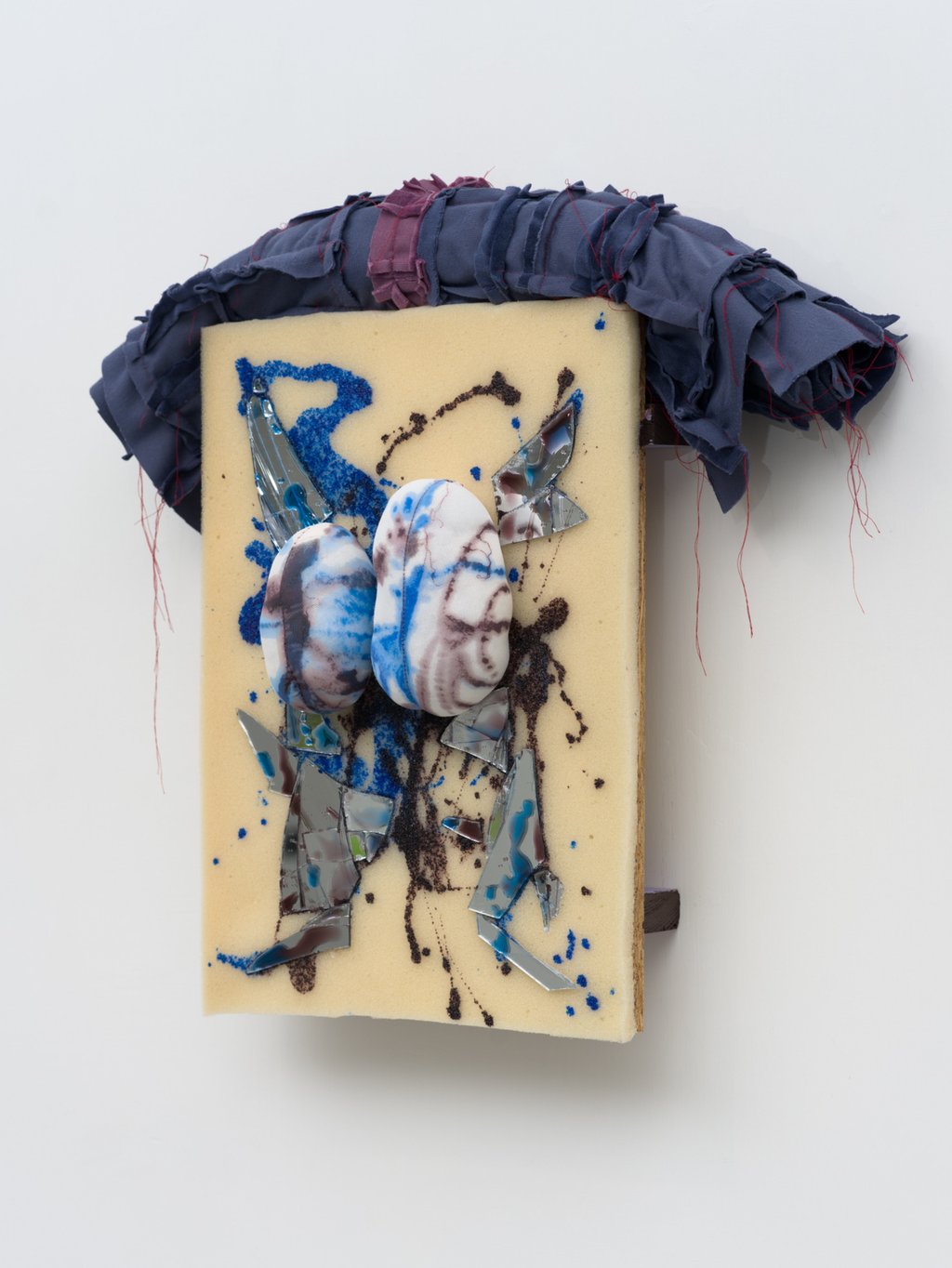
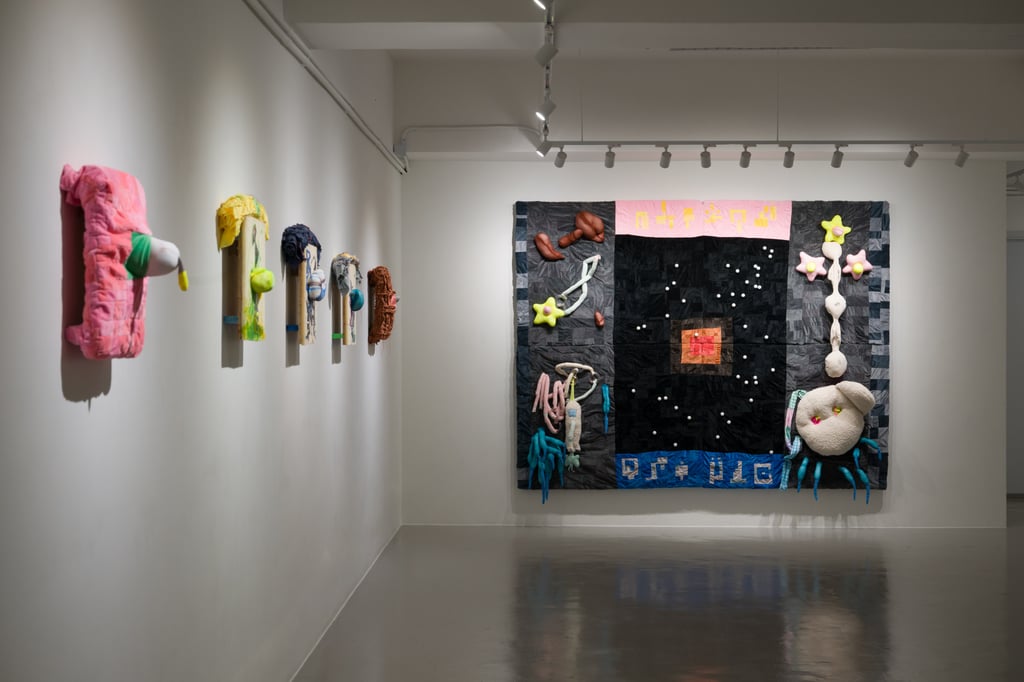
Her latest exhibition, “On the Edge of Passage” at SC Gallery in Hong Kong’s Wong Chuk Hang neighbourhood, may look a little different, with its 16 colourful, soft, irregularly shaped textile relief sculptures. But it is centred on her usual concepts: fertility and materiality.
Most of the artworks are named after deities from ancient Egyptian mythology, which Chan says inspired her with its themes of life, death and desire.
Her piece Min (2025) is named after the fertility god often portrayed in male human form with an erect member. The purple wall relief has a protruding cylindrical shape peeking out from under layers of plush cloth. This shape recurs throughout the exhibition.
While it can be interpreted as a phallus, Chan sees it like the stigma of a flower or a nipple. There is an ambiguity in the bodily shape that she enjoys.
Chan read about how ancient Egyptian mythology emphasised the idea of an afterlife and a safe transition to it.
In Kephri Kernel (2025) – named after Khepri, the Egyptian god of creation and the rising sun – the reddish square in the centre represents a beetle amulet, also known as a scarab. These trinkets were sometimes placed on the chests of the dead to protect them during their journey to the afterlife.

The toylike forms on two sides of Chan’s artwork are fragmented body parts that serve as symbols of childlike innocence, almost like burial items.
As well as motherhood and childhood, Chan also expresses her ideas about fertility.
In many of the soft sculptures at the exhibition, she uses geometric patterns that resemble the traditional Chinese patchwork style of shuitianyi, or “paddy field garments” – traditional women’s gowns made of scrap fabrics that emerged during the Ming dynasty (1368-1644).
“As I worked with the textile materials, I started wondering about women from the past and discovered the style of shuitianyi. What is the difference between my labour and that of those women who made shuitianyi?” Chan asks.
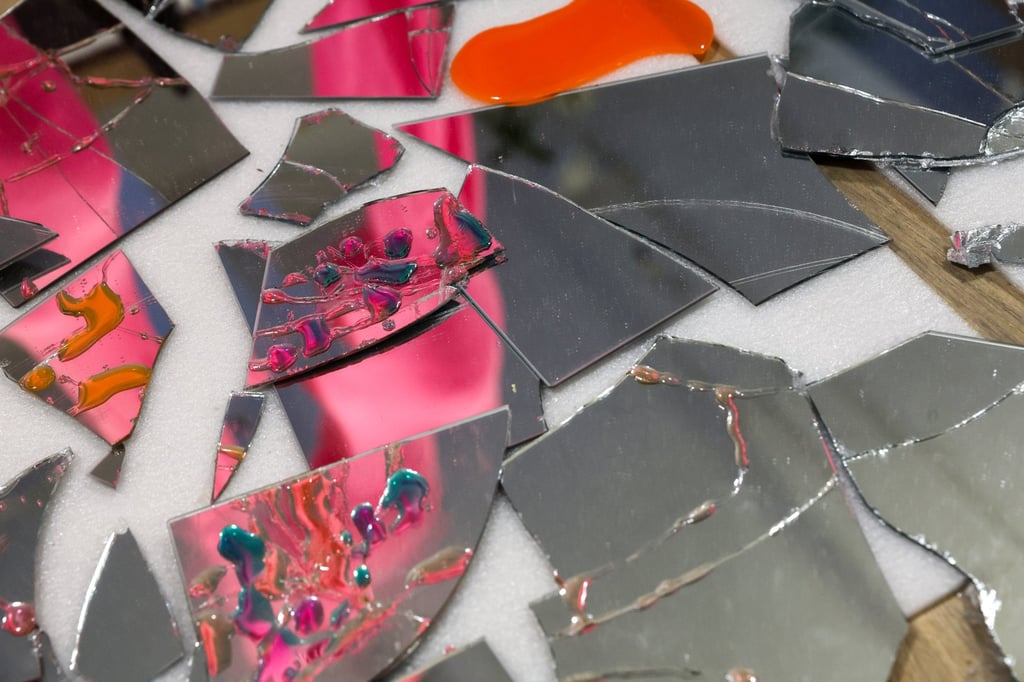
She adds that her threaded work involves a lot of repetition, which creates a meditative state where she can “subconsciously release an organic, delicate rupture” in the otherwise grid-like, rigid framework.
In confronting binary, fixed positions, her art is ultimately about opening up meanings, she says.
“I’m drawn to the danger in rawness and looseness. I want to be very aligned with materiality. Sometimes there’s a resistance, but I get to explore different possibilities in my response.”
“On the Edge of Passage” at SC Gallery, 1902, Sungib Industrial Centre, 53 Wong Chuk Hang Road, Wong Chuk Hang, Hong Kong Island, Tuesday to Saturday, 11.30am to 6.30pm. Until Oct 18.

